In Progress: ICH's Other Book - Of Nature and Art

Andro

Alchemical Adept
Magus de Moderatio
Patron of the Arts
Honorable Meister
Hermetic Pilgrim
Joined
Dec 10, 2009
Messages
8,262
Happy to announce that I'm currently working on translating the book 'Of Nature and Art' ('Von der Natur und Kunst') by none other than ICH, the author of 'Hermes Trismegistus' Old and True Natural Path', a.k.a. "Naturweg".

It's a collaboration with alchemy-texts.com - the owner of the site ran the Old German text (linked above) through AI, for transcribing it into modern fonts and for providing a "starter" English translation, which has countless errors and flaws. I am currently going through the modernized text side by side with the Old German Text and manually correcting every word, phrase, paragraph and synonym. Old German Fraktur is not easy for me, but it's not impossible either, so it's quite painstaking, but I think it's worth it.

Once finished, the English text will be available for free, on the Alchemy Texts website and likely as a downloadable PDF here on Alchemy Forums.

There is a pathetic excuse for a translation in RAMS, but it's a joke. Only 18 pages are translated there, out of more than 100.

As of now, I'm done with the part written by ICH himself, which comprises about 1/3 of the book. The rests consists of excerpts from other books, that the publisher thought to be relevant and worth publishing under the same title.

If no major disruptions occur, it should be done some time in November.
 

Illen A. Cluf

Hermes Trismegistus
Honorable Meister
Hermetic Pilgrim
Joined
Jan 1, 2009
Messages
1,883
Thank you for your generosity, Andro! I'm looking forward to the result, as this is a very important work.
 

alfr

Rectificando
Hermetic Pilgrim
Joined
Feb 5, 2010
Messages
491
Thank Andro for your generosity very thank Andro!

my best regard Alfr
 

Philosophical

Terrae
Hermetic Pilgrim
Joined
Dec 2, 2015
Messages
300
Eagarly awaiting this. Thanks for your effort on a thorough translation, it is any wonder RAMs bothered with some of their translations..
 

Lux Natura

Occultum
Honorable Meister
Hermetic Pilgrim
Joined
Aug 25, 2016
Messages
667
Thank you. Should be an interesting read.
 

Illen A. Cluf

Hermes Trismegistus
Honorable Meister
Hermetic Pilgrim
Joined
Jan 1, 2009
Messages
1,883
Here's a preliminary translation of an important part of the afore-mentioned book "Of Nature and Art":

"In regard to its origin, it is partly heavenly and partly earthly, for it must originally be born a spirit of light, which spiritually possesses the two central fires. Now this spirit, just as it once hovered upon the waters at the beginning of all creation, abides, according to divine order, even to this very hour upon them, for the preservation and increase of all creatures.

It is, however, earthly because it at the same time obtains its existence and corporeality through an earthly being, whereby it becomes a participant in both the lower and higher powers of nature. According to its heavenly origin, or as a spirit, it possesses all the powers of heaven and dwells in the air — which for this reason is also called the Sea of the Wise.

Basilius says of this: “The tincture’s root of all metals is a supernatural flying fiery spirit, which dwells in the air and naturally seeks its abode in the earth and water; and the air is precisely that secret and hidden earth which hovers above our heads, and from which, through the elemental conversion, the nitre of the Wise is drawn.”

Paracelsus writes likewise: “One must know the anatomy of the living body, and from it be able to extract the essence (without injury to the body), through which all the wonders of the world can be performed.” This would then be the greatest secret, which the Adepti have kept hidden under a veil.

By this, Paracelsus means to signify that one must not seek the two central fires in an improper way from within man, but rather take that which human nature expels as superfluous. For Ur in Caltha contains within itself the cold central fire, which consists in its very noble salt — and this is our magnet. Philaletha calls it Moon and Venus.

Likewise, the red — that is, the stercus adamica terra, or Adamic dung-earth — as electrum minerale immaturum, contains the most excellent electrum electissimum, the Wise’s secret mineral of Saturn, which has not yet been in any fire, and within which, according to its power, all metals lie hidden, and from which they may be obtained — likewise the minerals of Antimony, Mars, and the Sun, the sulphur of the philosophical Mars and of gold, within which resides the warm central fire, or our vinegar-like sulphur, by which our astral Mercury is animated; for this sulphur is the strongest fire and the greatest balm of nature.

However, lest one be led astray by such mineral terms, Sendivogius warns, saying that one must not seek the warm central fire in the common metals of the common man, for these — especially the gold of the common man — are dead, whereas ours is living and possesses a spirit. This is what must be taken."
 

Andro

Alchemical Adept
Magus de Moderatio
Patron of the Arts
Honorable Meister
Hermetic Pilgrim
Joined
Dec 10, 2009
Messages
8,262
Yeah, basically it's a Piss-Kaktum work.

"Ur in Caltha" = Urine

"Stercus Adamic" = Human (adamic) fecal excrement (or dung/manure). In Latin, Stercus means "feces" or "excrement".

In ICH's model, the human being attracts the Astral Spirit through the lungs via breathing, it goes into the blood ("Red Sea"), and from there into the bladder and out through the "Fountainhead", which is elsewhere also referred to as "the source of both joy and sorrow"...

The urine is collected during the spring months, before sunrise, especially when the moon is waxing. The "magnet" should ideally be young and healthy, and breathe while facing North.

Conversely, the "Stercus" is to be collected at noon (the famous "knee-deep digging").

The famous "mine of 30 years standing" is the preferred average age of the human magnet, which ICH places between 20 and 40.

Everything will be much clearer once the entire book is translated and publicly available. But it also adds some clarity to Naturweg and perhaps also to the later iterations from this lineage.
 

Illen A. Cluf

Hermes Trismegistus
Honorable Meister
Hermetic Pilgrim
Joined
Jan 1, 2009
Messages
1,883
"Ur in Caltha" = Urine
Yes, I had earlier noticed the pun "ur in". Directly, "Ur in Caltha" refers to the biblical Ur of the Chaldees. In German "urine" is "urin". "Caltha" itself is a bit of a mystery. Although it refers to the Biblical "Chaldees", in German, it literally means "marigold". Thus it may refer to the yellow/golden colour of urine, or it represents the sulphur principle, although urine typically represents the mercury principle or even the salt principle (the "water that does not wet the hands").

When the two treatises are compared, the entire process is clearly explained - the theoretical as well as the practical parts.

I have read a crude translation of the entire treatise. It does mention adding common Mercury towards the end of the process (as well as common Gold), which greatly concerns me. I would not want to ingest anything that contains common Mercury. Thus, if you do try this out for curiosity, be very careful not to ingest it.

This author seems to have been inspired by the writings of Sendivogius amongst others.
 
Last edited:

Andro

Alchemical Adept
Magus de Moderatio
Patron of the Arts
Honorable Meister
Hermetic Pilgrim
Joined
Dec 10, 2009
Messages
8,262
When we read about it going through the bladder, we realize it refers to urine literally, not metaphorically.

It does mention adding common Mercury towards the end of the process (as well as common Gold), which greatly concerns me. I would not want to ingest anything that contains common Mercury.
The addition of metals in the end (Hg & Au) is to specify, ferment and quantitatively multiply the tincture for transmutation purposes. No mention of ingesting it with Mercury, it's only for transmutation.

When the two treatises are compared, the entire process is clearly explained - the theoretical as well as the practical parts.
When we read this book and Naturweg, we see they have a lot in common, but they do not describe the exact same process. Very similar, but not the same.

I have read a crude translation of the entire treatise.

I recommend to wait patiently for the refined translation, it will be much more wholesome and accurate..
 

Lux Natura

Occultum
Honorable Meister
Hermetic Pilgrim
Joined
Aug 25, 2016
Messages
667
@Illen A. Cluf I mentioned this in the other thread (one vessel etc) about 10 years ago as well.

A bit more etymological digging makes it pretty clear I think, the "urine" is in the "caltha" the same way many yellow / red oils are in salts. Caltha has interesting roots and a bit of a mystery to trace it all the way back, but with the internet its become trivial to find such things, whereas in the far past it meant you had to be an accomplished scholar with knowledge of several languages to even start to get a hint. I still think the correct breakdown is "Ur" in "Catha", and yes there is the pun of 'ur in' in there, and in fact it tells you how to get the urine out of the caltha - the whole 3 word phrase is very well constructed puzzle that breaks pretty easy and is straight forwards.

I think the whole urine and feces play was the last stop to conceal - or even just a bit of humor. I mean, yeah, you can process enough feces to get a material you can work with to extract the ur from therein, but its a bit backwards I think to do that - you can just get the matter to work with in much easier and cleaner and less smelly ways, even if you are poorer than poor.
 

Illen A. Cluf

Hermes Trismegistus
Honorable Meister
Hermetic Pilgrim
Joined
Jan 1, 2009
Messages
1,883
When we read about it going through the bladder, we realize it refers to urine literally, not metaphorically.

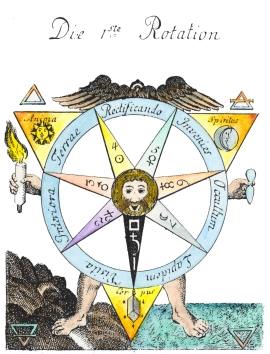
Here is one of the illustrations in the book. Is that a pinched bladder in his left hand?

amcl265.jpg

Source: Adam McLean.
 

Illen A. Cluf

Hermes Trismegistus
Honorable Meister
Hermetic Pilgrim
Joined
Jan 1, 2009
Messages
1,883
@Illen A. Cluf I mentioned this in the other thread (one vessel etc) about 10 years ago as well.

A bit more etymological digging makes it pretty clear I think, the "urine" is in the "caltha" the same way many yellow / red oils are in salts. Caltha has interesting roots and a bit of a mystery to trace it all the way back, but with the internet its become trivial to find such things, whereas in the far past it meant you had to be an accomplished scholar with knowledge of several languages to even start to get a hint. I still think the correct breakdown is "Ur" in "Catha", and yes there is the pun of 'ur in' in there, and in fact it tells you how to get the urine out of the caltha - the whole 3 word phrase is very well constructed puzzle that breaks pretty easy and is straight forwards.

I think the whole urine and feces play was the last stop to conceal - or even just a bit of humor. I mean, yeah, you can process enough feces to get a material you can work with to extract the ur from therein, but its a bit backwards I think to do that - you can just get the matter to work with in much easier and cleaner and less smelly ways, even if you are poorer than poor.
Thanks, @Lux Natura ! So what do you think is the root meaning of "Caltha", if not "Chaldees" or "Marigold" or even "Buttercup"?
 

Andro

Alchemical Adept
Magus de Moderatio
Patron of the Arts
Honorable Meister
Hermetic Pilgrim
Joined
Dec 10, 2009
Messages
8,262
I think the whole urine and feces play was the last stop to conceal
In the case of ICH, I very much doubt that it conceals anything.

Again, please wait for the more wholesome translation.

Also, quoth Wikipedia: The generic name Caltha is derived from the Ancient Greek: κάλαθος (kalathos), meaning "goblet".

Here is one of the illustrations in the book. Is that a pinched bladder in his left hand?
Not unlikely, especially when we also see where the Corpus originates/exits from. ICH also explicitly mentions the bladder, how the Nitre from Night Air is taken in by breathing, passes through the blood ("Red Sea"), makes its way to the bladder and exits from the "fountain", which incidentally also happens to be "the cause of both joy and sorrow" :)
 

Lux Natura

Occultum
Honorable Meister
Hermetic Pilgrim
Joined
Aug 25, 2016
Messages
667
@Andro wiki is a good starting point, but not the ultimate authority on anything. Certain words can easily be seen to derive from a source, others not so much. The Calathus is a vase very much like an upside down top hat, used to historically hold wool or fruit, and a symbol of abundance and fertility (compare with the idea of the horn of plenty for example). Cytherea (cyprian aphrodite) wore the basket as a head-dress. The likely connection was that the basket shape was originally woven from certain plant shoots, or the plant had itself a certain shaped flower (but in this case it precludes any possibility of the flower being marigold, sunflower, or any of the asteraceae flowers).

The whole concept of caltha referring to a specific plant comes from 2 sources (and really just 1): Freud personal Latin dictionary, which ultimately references Pliny, more specifically a footnote in the book about flowers. Here is the whole text the etymology is based on:

"Nearest to it comes the caltha,* both in colour and in size. In the number of the petals it exceeds the marine violet, which never has over five. The same plant is surpassed in scent, that of the caltha being strong. No less strong is the scent of the plant which they call royal broom, though it is not the flowers that smell, but the leaves."

And the footnote:

*"Some say the marsh marigold. Perhaps some variety of pansy"

So the whole concept of what plant "caltha" refers to is based off of something Pliny added as a footnote to a plant that was never properly identified to begin with - either calling it the marsh marigold or a viola (pansy) which look nothing like one another. There is something a bit amiss here with Pliny - he mentions that the caltha has more petals than the marine violet (violets have 5 petals), but he says it could be a pansy (which is a type of viola, that also only has 5 petals). It is more than likely that what is happening is this specific text was never actually checked for accuracy - Pliny produced massive volumes of work and likely much of it was just collected from other sources. If nothing else, this footnote actually shows a glaring error that was never caught.

I mention all this because it is all to easy to just google a few words from wikipedia and take them to be some sort of authority on something, and then pass that off as something concrete, yet with a bit of further digging one can see that by taking that one face value one is being misinformed. Something to think about.

Very much looking forward to the translation.
 

Andro

Alchemical Adept
Magus de Moderatio
Patron of the Arts
Honorable Meister
Hermetic Pilgrim
Joined
Dec 10, 2009
Messages
8,262

Lux Natura

Occultum
Honorable Meister
Hermetic Pilgrim
Joined
Aug 25, 2016
Messages
667
Thanks, @Lux Natura ! So what do you think is the root meaning of "Caltha", if not "Chaldees" or "Marigold" or even "Buttercup"?
Not wanting to step on others toes, I'd rather discuss this in private. A bit of the plant kingdom stuff here and some sources instead:

Linnaeus made a mistake when he identified the marsh marigold (buttercup) with Caltha - more likely it referred to the pot marigold (calendula) - but this is just a historical curiosity.

Calendula is one of the heavy lifters in medicinal plants, and has been known about for quite a long time (was originally brought into europe from africa), and the marsh marigold is basically poisonous (it belongs to the ranunculaceae family, most of which is poisonous). I spent quite a bit of time studying plant naming and etymologies in school - I think there was a book in the 1910's /1920's that sought to trace all the latin roots of plant names that Linnaeus used and it references Virgil.

I posted the Pliny version of Caltha above, the Virgil version comes from Eclogue 2 lines 45-50, and is even less clear than Pliny, and a big part of the issue is that all translations basically use Pliny's caltha = marigold. Virgil mentions this flower along with lilies, violets, poppies, narcissus, the anise flower, casia, sweet scented herbs, hyaciths, posies, and caltha (which is again, never actually defined).

I think the key takeaway from this is pointing towards something that is undefined, and only through Pliny's footnote is Virgils use of the plant defined (and basically between the two of them, there is no other mention of this flower). It's interesting enough to me, and I think this is why it was chosen to be a symbol or a representation of something else. That's my thinking about it anyway. The small bit of a hint is that it is likely actually the calendula and not the buttercup, and the importance of this is again from the medicinal and dyeing benefits of calendula.

Anyone that would spend the time to try to trace what "caltha" is, back in the old days, would ultimately end up cross referencing these two books from Pliny and Virgil, and realize that they are no closer to finding an answer, because neither says what it is. It's an ingenious little bit of a puzzle trickery - but they are left with "something" that can be used to make medicine, and use to make dyes. A bit relevant to the alchemy world, IMO.
 

Illen A. Cluf

Hermes Trismegistus
Honorable Meister
Hermetic Pilgrim
Joined
Jan 1, 2009
Messages
1,883
Not wanting to step on others toes, I'd rather discuss this in private. A bit of the plant kingdom stuff here and some sources instead:

Linnaeus made a mistake when he identified the marsh marigold (buttercup) with Caltha - more likely it referred to the pot marigold (calendula) - but this is just a historical curiosity.

Calendula is one of the heavy lifters in medicinal plants, and has been known about for quite a long time (was originally brought into europe from africa), and the marsh marigold is basically poisonous (it belongs to the ranunculaceae family, most of which is poisonous). I spent quite a bit of time studying plant naming and etymologies in school - I think there was a book in the 1910's /1920's that sought to trace all the latin roots of plant names that Linnaeus used and it references Virgil.

I posted the Pliny version of Caltha above, the Virgil version comes from Eclogue 2 lines 45-50, and is even less clear than Pliny, and a big part of the issue is that all translations basically use Pliny's caltha = marigold. Virgil mentions this flower along with lilies, violets, poppies, narcissus, the anise flower, casia, sweet scented herbs, hyaciths, posies, and caltha (which is again, never actually defined).

I think the key takeaway from this is pointing towards something that is undefined, and only through Pliny's footnote is Virgils use of the plant defined (and basically between the two of them, there is no other mention of this flower). It's interesting enough to me, and I think this is why it was chosen to be a symbol or a representation of something else. That's my thinking about it anyway. The small bit of a hint is that it is likely actually the calendula and not the buttercup, and the importance of this is again from the medicinal and dyeing benefits of calendula.

Anyone that would spend the time to try to trace what "caltha" is, back in the old days, would ultimately end up cross referencing these two books from Pliny and Virgil, and realize that they are no closer to finding an answer, because neither says what it is. It's an ingenious little bit of a puzzle trickery - but they are left with "something" that can be used to make medicine, and use to make dyes. A bit relevant to the alchemy world, IMO.
OK, but the point is that I doubt whether I.C.H. would have been aware of all the implications involved in tracing the true origin of the word, and would have likely used the same common understanding of the word prevalent at the time: "Marigold" (likely marsh Marigold)."Ur" is almost definitely realted to the "Ur" mentioned in the Bible - the "Ur of the Chaldees. Thus, on the surface, "Caltha" likely referred to "Chaldees", but again, using a pun, the word was similar to "Caltha" ("Marigold") which was his real intent. "Ur in" is obviously a pun for "urin" (German for "urine").

So the real question is why he would associate "urine" with "Marigold"? The bright gold-like colour is obviously one of his intents, but is there another? Or is he simply just empahsizing his puns by hinting at the yellow-coloured urine to ensure there is no mistake about his matter?
 

Lux Natura

Occultum
Honorable Meister
Hermetic Pilgrim
Joined
Aug 25, 2016
Messages
667
@Illen A. Cluf where exactly is the "ur in caltha" found? I had only read it "The First Matter" / anonymous which is already in English. Is this piece actually in the translation of the ICH text this thread is about? Is "ur in caltha" found in that original german text, if so, what page? Context likely matters.


My belief is that the idea that "caltha" = "marigold" is wrong, and there was no use of that world "caltha" in the german language at the time. If anything, they would have used goltblum/ ringula.

The most basic way to explain it, is that Virgil first used that word to refer to a plant (but without any description) as part of plants that were collected in a poem - all more or less field plants. Later, Pliny mentions it, but only gives the description of it having more than 5 petals (more petals than a violet), and he writes a footnote on it, saying that "caltha" could refer to "heavy caltha" but again, we have no actual details. These are the only 2 mentions of "caltha".

Linnaeus, in 1750s or 1760s, publishes his work, and therein he associates caltha with marsh marigolds, although he is unsure of this, as it was not native to where Virgil lived nor does it fit the poem. All English translations of Virgil / Pliny afterwards thus have marigold as part of the translation.

ICH writes his work a short while later, and uses the word "caltha".

All modern etymologies of caltha as marigold are informed by what Linnaeus chose as the latin binomial name for the plant, and there is no other actual evidence of this being correct, and there are no descending etymologies from other languages that borrowed this from the Romans except for one, the Albanian kalter, which actually means "sky blue" - a far cry from the yellow of Linnaeus's marsh marigold or the yellow/orange of goltblum/ringula.

Now, there is a word that is similar to "caltha" in fact similar enough that if you heard it said out loud, you may have though you heard "caltha", or also the possibility of a transcription or typesetting error.

In a roundabout way, you can get this out of feces, and it doesn't hurt to mix the urine in while you are at it, but it's a very odd way of working, if what you are after is that material, as you can literally just get it from so many other things much more easily.
 

Illen A. Cluf

Hermes Trismegistus
Honorable Meister
Hermetic Pilgrim
Joined
Jan 1, 2009
Messages
1,883
@Illen A. Cluf where exactly is the "ur in caltha" found?

It's on Page 43 of the treatise (see below). If "Caltha" was mentioned in a work by Linnaeus just prior to when I.C.H. published his own work, and in that, "caltha" meant "marsh marigold", then doesn't that provide a strong indication that I.C.H. also meant "Marigold"? I don't see how you can then deny it. I.C.H. would not likely have known about the etymology but just used what was undertood at the time.

1762055314076.png
 

Lux Natura

Occultum
Honorable Meister
Hermetic Pilgrim
Joined
Aug 25, 2016
Messages
667
Thanks for the image @Illen A. Cluf. The translation is straight forwards - I wonder if ICH himself did not hear this term or got it from somewhere else and there was a mishearing / mistranslation of it.

Most people generally don't use the latin binomials when referring to plants - instead they use the common names. The whole reason for Linnaeus was to provide a standardization because there were altogether too many common names for plants, and it was all region specific, but this was mainly to provide coherence within the academic side of things. He was also racing against other naturalist who had their own systems of classifications (many with 3 or more latin names i.e. trinomial etc) . The actual binomial would be Caltha palustris, and very much with ICH not using the full binomial it is evident that his use of this term has nothing to do with Linnaeus' classification. The push for the binomial as a form of standardization was very strong with Linnaeus, and the idea of just using the first part, the genus, as if that was a "common term" that could be used to accurately describe both the genus and species is exactly the kind of thing he was working to get away from. To be clear, if ICH would have said "Denn Ur in Caltha palustris ... then the line of reasoning makes sense that he was informed by Linnaeus, but otherwise it seems that his use of the word means something else, and I think if he actually meant marigolds, we would see "Denn Ur in Goltblum ..."

It's the same today - you don't tell someone you planted Daucus in your garden, you say you planted carrots, and if you did say Daucus you would actually follow that up with the full Latin binomial, because the point of it is to be specific to the species / variety / cultivar, i.e. Daucus carota subspecies sativus "Red Cored Chantenay" (that last bit would be the cultivar). There is basically no situation where one just uses a genus name. If you talked to someone and they told you they planted Daucus, and you know binomials, you would either roll your eyes so hard they would detach from their optic nerves, or wait for them to actually tell you the rest of the full Latin name, in case it was some exceeding interesting species because you are both plant nerds, and you know nobody uses the Latin names for these things unless there is a very good reason why one needs to be clear.

I know this all seems like such a minor thing, and I am really trying to show that it is significant. The difficulty is that the context is subtle, and it's not enough to say that if Linnaeus used the term Caltha (as part of a 2 part Latin name) then ICH's use of one of the term is the same, because the specifics are different, and the exactitude of how these Latin binomials are used is literally the whole point of having them in the first place.

One last bit - you say ICH would not have known about the etymology - this is something I was mentioning above - prior to Linnaeus making this connection of caltha with the marigold, there was no etymological connection between these two concepts. The term caltha essentially gets lost, and the Romans don't pass it on to anyone. Linnaeus plucks it out of history and gives it a meaning. The Greek word its supposed to be based on shares no concepts with the Latin word either (although etymologists try to twist it to fit).

There is an etymology that I think is more fitting that is derived from a specific spoken Roman dialect that I think makes sense, but I will wait to read the translation to see if that fits with what he talks about before I say what my point of view on that is.
 

Andro

Alchemical Adept
Magus de Moderatio
Patron of the Arts
Honorable Meister
Hermetic Pilgrim
Joined
Dec 10, 2009
Messages
8,262
ICH, in both his books, repeatedly states that the magnet, i.e. the cold central fire (cold = kalt in German) comes out of a living human, overflowing of itself, without injuring the body. Ur in Caltha is very likely a pun for indicating Urin, possibly also coldness (which translates to Kälte in German) and may also be a bad spelling (typical for the era) of the place from where the biblical Abraham started his journey. Chaldea, where the city of Ur allegedly existed, has been called different names in different languages, e.g. Kasdim, Kaldayim, Kaldo, Kaldu, etc. Since D and TH (as well as K and C) are often interchangeable, Kaldu can become Kalthu can become Calthu can become Caltha. Similarly, Chaldea can become Chalthea can become Caltha, due to the same aforementioned interchangeability between D and TH.

Furthermore, in the Latin version of the bible, Avram/Avraham is said to have been residing in Ur Chaldæorum, meaning in Ur of the Chaldeans (plural). Chaldea would be the name of the land or its people (singular) => so using Ur in Chaldea or Ur in Caltha (as a biblical pun) would not be far-fetched at all, especially as those Alchemical authors were very much Bible and Latin buffs, as most of their writings indicate, although with plenty of "dog Latin", supplemented with lots of poetic license... It is more likely they were reading the Latin Bible (Ur Chaldæorum), and not the Hebrew version, where the place is called Ur Kasdim.

ICH also repeatedly states that the Matter must be sought in Man alone, because Man is the pinnacle of creation, being the last/final/ultimate created being, on the 6th day, after which God rested and stopped creating any further, and where-from Art must continue. ICH additionally laments how many are deceived in thinking that metallic gold is the natural perfection from which Art must proceed, specifying that the pinnacle of creation is not gold but Man, and it is from Man, i.e. the best and last of Creation, that Art must take its beginnings.

This is only for ICH's works, and doesn't necessarily pertain to other alchemical lineages.

This being said, if you ask me, neither minerals, vegetables, animals or human Piss-Kaktum can give us the pinnacle of Alchemy. For the ultimate, we must commence at the very beginning, reverse-engineer Genesis and start with the primordial building blocks, the initial, incorporeal "Heaven" and "Earth". IMO.

However, ICH's books give us a unique glimpse into his R+C lineage and world-view, which regards Man as the best and ultimate sum-total of all Creation.

Here is another small excerpt from the translation (I'm currently proof-reading the part written by ICH himself):

"So when you wish to prepare the 🝈 Tincture from the microcosmic realm, that is, from the Center, mark what our forefathers have said about such a matter: that Adam carried this matter out of Paradise, and that the poor as well as the rich have it in their possession, indeed, the poor often more than the rich because the latter, through a disorderly life, spoil his matter and make it unfit for the Art.

Thus Gloria Mundi also writes that this matter is born every day in the 🜁 Air, out of a vapor from the ☉ Sun and the ☽ Moon, and travels through the ▽ Water streams of the Red Sea into the Fountain of Nature; from that same [Fountain] one must take it and gather it.

This is to be understood thus: in the human being, the lungs are the attracting and drawing instrument, but the ▽ Water out-flows take place per circulationes sanguinis usque ad vesicam [through the blood’s circulation to the bladder]. Man has everything gathered together in one pouch, and he must not be too old, but in his best years, from 20, 30 to 40 years, and of sound (healthy) constitution."

​
 

Jimmy Rig

Lapidem
Hermetic Pilgrim
Joined
May 10, 2021
Messages
1,001
ICH, in both his books, repeatedly states that the magnet, i.e. the cold central fire (cold = kalt in German) comes out of a living human, overflowing of itself, without injuring the body. Ur in Caltha is very likely a pun for indicating Urin, possibly also coldness (which translates to Kälte in German) and may also be a bad spelling (typical for the era) of the place from where the biblical Abraham started his journey. Chaldea, where the city of Ur allegedly existed, has been called different names in different languages, e.g. Kasdim, Kaldayim, Kaldo, Kaldu, etc. Since D and TH (as well as K and C) are often interchangeable, Kaldu can become Kalthu can become Calthu can become Caltha. Similarly, Chaldea can become Chalthea can become Caltha, due to the same aforementioned interchangeability between D and TH.

ICH also repeatedly states that the Matter must be sought in Man alone, because Man is the pinnacle of creation, being the last/final/ultimate created being, on the 6th day, after which God rested and stopped creating any further, and where-from Art must continue. ICH additionally laments how many are deceived in thinking that metallic gold is the natural perfection from which Art must proceed, specifying that the pinnacle of creation is not gold but Man, and it is from Man, i.e. the best and last of Creation, that Art must take its beginnings.

This is only for ICH's works, and doesn't necessarily pertain to other alchemical lineages.

This being said, if you ask me, neither minerals, vegetables, animals or human Piss-Kaktum can give us the pinnacle of Alchemy. For the ultimate, we must commence at the very beginning, reverse-engineer Genesis and start with the primordial building blocks, the initial, incorporeal "Heaven" and "Earth". IMO.

However, ICH's books give us a unique glimpse into his R+C lineage and world-view, which regards Man as the best and ultimate sum-total of all Creation.

Here is another small excerpt from the translation (I'm currently proof-reading the part written by ICH himself):

"So when you wish to prepare the 🝈 Tincture from the microcosmic realm, that is, from the Center, mark what our forefathers have said about such a matter: that Adam carried this matter out of Paradise, and that the poor as well as the rich have it in their possession, indeed, the poor often more than the rich because the latter, through a disorderly life, spoil his matter and make it unfit for the Art.

Thus Gloria Mundi also writes that this matter is born every day in the 🜁 Air, out of a vapor from the ☉ Sun and the ☽ Moon, and travels through the ▽ Water streams of the Red Sea into the Fountain of Nature; from that same [Fountain] one must take it and gather it.

This is to be understood thus: in the human being, the lungs are the attracting and drawing instrument, but the ▽ Water out-flows take place per circulationes sanguinis usque ad vesicam [through the blood’s circulation to the bladder]. Man has everything gathered together in one pouch, and he must not be too old, but in his best years, from 20, 30 to 40 years, and of sound (healthy) constitution."

​
Hi Andro,

I understand clearly your view here.
Urine being ultrafiltrate from blood.. diluted plasma as it is..
There is a sort of barrier to entry to working with the latter.
I think the below quotes link well to your train of thought.
One from Frater Albertus and one from myself.
The Alchemist's Handbook- Exerpt from page 30.
"If, by divine wisdom, man as highest specimen of the animal realm, has been placed in the middle of the three kingdoms, it has been of necessity, since nothing in nature is based on chance. Man is holding the balance of the three kingdoms and can partake of any one according to his liking, having an alchemical laboratory in his own body to transmute inorganic matter into organic, and organic into spiritual matter. Since these are actualities with which we are confronted, we must deal with them and attempt to understand them. Only laws that are basic and of true cosmic value enter Alchemy. There can be no speculation in Alchemy. Alchemy is based upon facts and, with patience, experimentation and perseverance, the sincere student will obtain these facts. There is no other way than the one all Alchemists have traveled, and this is the way of experience.
In light of some of the past posts on this site dealing with raising of frequency of the alchemist via the tincture.. one can draw some conclusions on a possible route here of stepping up matter to a spiritual state to be used as a sort of cosmic ladder...What is spiritual matter transmuted to? What about spiritual matter that is transmuted, and then transmuted again? (stepping up)
Some other relevant links below.
I would like to share some thoughts here if you all do not mind.

Had a word pop up in my consciousness dreaming the other night, and randomly over the last few days since..
Vampyre/ vampire

So; I thought to myself.. Vampire..
Pire makes me think of Fire; or Pyro;
And, putting aside modern meanings; yes there is something to this Etymology

"Pyre" Learned borrowing from Latin pyra (“pyre, funeral pile”), from Ancient Greek πυρά (purá), from πῦρ (pûr, “fire”), from Proto-Indo-European *péh₂wr̥. Doublet of fire."

Also a pyramid has the same shape as the symbol for Fire alchemically.

Now; what about "Vam"

What does -vam‎ mean?

see also vam, vám

-vam (Latin)​

Suffix
-vam
  1. Inflection of -vus (accusative feminine singular)

This is the meaning of -vus:
-vus (Latin)
Origin & history

From the Proto-Indo-European perfect active participle suffix *-wós.

Pronunciation​

  • (Classical) IPA: /wus/
Suffix
-vus
  1. Alternative form of -uus
    arvus, clīvus, corvus, flāvus, vīvus
Usage
  • Originally forming the perfect active participle, as in alvus ("entity having nourished"), clīvus ("entity having leaned"), gnāvus ("having known").
  • The form -vus is used after vowels, l, and r, and -uus after all other other consonants, with the exception of qu. In this last case, the form -us is used."
Now; the link I am making here is that vampyre could; if we are being relaxed in our interpretation be "entity having nourished-fire" , "entity having learned-fire" or "entity having known fire".

Chapter 1

What Nature is.​

Nature comprehends the visible and invisible Creatures of the Whole universe. What we call Nature especially, is the universal fire or Anima Mundi, filling the whole system of the Universe, and therefore is a Universal Agent, omnipresent, and endowed with an unerring instinct, and manifests itself in fire and Light. It is the First creature of Divine Omnipotence."
~The GCH

If you were a being of fire/light you would not cast a shadow. There would be no image to reflect in a mirror, you would just see light.

"A shining one"

On a side note, vampires are known to suck the victims blood WHILE THEY ARE STILL ALIVE; this would IMO be a very potent source of quintessence would it not? (being the light) or "5th" element. Interesting.

I am not endorsing the idea or practice or sympathize with the idea of sucking blood; but I do find it interesting in light of some of the other posts kicking around these forums.
Another small point to make, all animated (living) beings incorporate the quintessence into their being, and must do so in order to be animated(living) by it. So the juices extracted from a plant, man, or living mineral.. its not so different... This is the same reason why true spagyrics are alchemical. The essences from the different kingdoms look the same. Tinctures from different subjects all end up looking the same, a red to golden fluid when dissolved in pure alcohol.
 

Andro

Alchemical Adept
Magus de Moderatio
Patron of the Arts
Honorable Meister
Hermetic Pilgrim
Joined
Dec 10, 2009
Messages
8,262
I understand clearly your view here.
This does not necessarily represent "my view". I am translating ICH's book "Of Nature and Art", so I do my best to accurately reproduce ICH's text, phrasing and reasoning in the translation, without inserting any of my own interpretations into the translated text itself. This, I leave up to the readers.

This current "debate" mainly revolves around the interpretation of ICH's original expression "Ur in Caltha". Based on the entire context of the book, I believe it explicitly refers to Urin (the German word for urine). Lux Natura seems to interpret it differently (but doesn't clearly say what his interpretation is), this is why I am providing additional context, but I hope it will all be much clearer when the entire translation is finished and published.

raising of frequency of the alchemist via the tincture
There's no talk in ICH's book (or in any other classical text I know) about "raising the frequency". This sounds more like a New Age concept.
 

Jimmy Rig

Lapidem
Hermetic Pilgrim
Joined
May 10, 2021
Messages
1,001
This does not necessarily represent "my view". I am translating ICH's book "Of Nature and Art", so I do my best to accurately reproduce ICH's text, phrasing and reasoning in the translation, without inserting any of my own interpretations into the translated text itself. This, I leave up to the readers.
Ah yes sorry. Not your view, just your presentation of part of the text you are translating.
This current "debate" mainly revolves around the interpretation of ICH's original expression "Ur in Caltha". Based on the entire context of the book, I believe it explicitly refers to Urin (the German word for urine). Lux Natura seems to interpret it differently (but doesn't clearly say what his interpretation is), this is why I am providing additional context, but I hope it will all be much clearer when the entire translation is finished and published.
I just read your post and wanted to add some thoughts to it :)
There's no talk in ICH's book (or in any other classical text I know) about "raising the frequency". This sounds more like a New Age concept.
I am just extrapolation some ways these things may be used, usefully. i.e. Q.E. containing sources. We could also call it "Enlightenment, Health, Wealth, Longevity, ultimate liberation(possibly)" etc. IMO