I recently came across an awesome book, which is basically a scientists journey of trying to understand the bizarre effects of studying water which produces an EZ zone adjacent to a boundary layer from a hydrophillic substance
[see HERE for a brief overview].
The title is "
The Fourth Phase of Water: Beyond Solid, Liquid, and Vapor" by Gerald Pollack, and I'm hereby officially putting as book number 4 on Ghetto's essential reading list for all wannaba alchemists in the 21st century.
[The other books are "The Platinum Canon Shipwreck", "The Hermetic Museum", and "The secret book of Artephius"].
There's a link
HERE to buy off amazon, or a free link
HERE for all you skinflints.
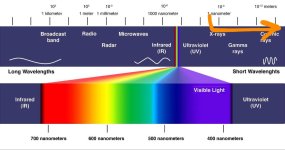
It's a fascinating read, and so I don't want to spoil it too much...but on page 96 the author talks about shining UV light through the EZ zone, and the resulting absorbtion curve is the exact same one produced by HIM containing spring water after being 'charged' in an orgone accumulator or MEOW device.
Which IMO means 2 things:
> Pollack was using distilled spring water in his experiments, but for some reason failed to mention this.
> The EZ zone is simply the HIM component of the water in a concentrated form.
I'm reminded of the time 17 years ago when Triune-one released videos of his experiments conducting electrolysis on spring water, and then released it to everyone to share in his journey of wonderment.
Anyway, the book has left my head spinning.
I've always wanted to know of a fast, easy and food-safe way of extracting the HIM portion from spring water.
[there's always been the options of ether extraction and fractional freezing, but food-grade ether doesn't exist and fractional freezing requires both time and empty freezer capacity which most people simply don't have].
Well, now there's a new option.... just place a layer of hydrophillic substance in the bottom of a HIM water vessel, and then slowly pull off the top bulk water by physically sucking it away or slowly evaporating it off.
You could even use the freezer method, but combine it with the EZ water effect to get the best of both worlds, because the EZ layer will be the last part to freeze.
In the book Pollack describes using nafion film to generate the EZ layer, which is very difficult to acquire, and expensive, even if you can get it
[and probably not food-grade either].
But I asked AI which substances work and it said:
- Hydrophilic Surfaces:
Surfaces that attract water molecules, such as cellulose, hemicellulose, and lignin (found in plant xylem cell walls).
- Fats:
Healthy fats like ghee, coconut oil, lard, organic clarified butter, and 'Brain Octane®' oil have been shown to promote EZ water formation.
- Nafion:
A material with oxygen atoms in its molecular structure that forms a template for the EZ water honeycomb.
- Plant Xylem:
The water-conducting tissue in plants, particularly the xylem vessels, is a potential site for EZ water formation.
This is great news because we can reproduce the effect using substances such as
ghee or coconut oil which are both food-grade and easy to acquire.
Coconut oil even has the advantage of turning to liquid at low warmth, so you can melt it and pour it into any shape you want.
Anyway, just putting it out there. Obviously it resonates with me, which means it'll probably be the same for some of you out there.
Enough said.